Blog

The Sun, the Moon, and the Trap of Comparison

It has become incredibly easy to look at someone else’s life and quietly decide that you are somehow behind. Behind in success, behind in happiness, behind in parenting, behind in health, behind in just about everything. The internet has given us a front row seat to everyone’s highlight reel. We see the vacations, the perfectly decorated homes, the thriving businesses, the glowing smiles in family photos. What we don’t see are the quiet, messy, complicated parts of life that everyone carries behind the scenes. And yet, if we’re not careful, we start measuring our ordinary Tuesday afternoons against someone else’s carefully curated moments.

I came across a quote recently that stopped me long enough to really think about it: “Don’t compare your life to others. There’s no comparison between the sun and the moon. They shine when it’s their time.” It’s such a simple image, but the more I thought about it, the more it made sense. The sun and the moon were never meant to compete with each other. The sun doesn’t look at the moon lighting up the night sky and think it’s somehow falling behind. It doesn’t rush the horizon trying to prove it can shine brighter. And the moon doesn’t apologize for not lighting up the middle of the day. They simply show up when it’s their time.

Life has seasons that feel like bright sunshine. Things move forward easily. Plans fall into place. You feel productive, hopeful, and confident that everything is working the way it should. But life also has seasons that feel more like moonlight. Those are the quieter seasons. The slower ones. Sometimes they’re the seasons where you’re healing from something, learning something hard, facing uncertainty, or just trying to make it through the day without letting worry take over. Those seasons can feel uncomfortable, especially when everyone else seems to be standing in the sunlight.

But the truth is, the moon is just as necessary as the sun. The world needs both. We tend to celebrate the bright seasons in people’s lives — the accomplishments, the milestones, the moments when everything seems to be going right. What we rarely see are the quieter seasons where people are rebuilding, recovering, grieving, growing, or simply learning how to keep moving forward. Some of the most important growth in life happens in those darker skies. When things slow down enough for us to listen to ourselves. When life forces us to reevaluate what actually matters. When we learn patience, resilience, and grace in ways that sunny days never quite teach us.

Comparison assumes that everyone is living on the same timeline, but that has never really been true. Some people are standing in their sunrise years. Others are in the bright middle of the day when everything seems clear and certain. And some of us are walking through a quieter stretch where the light looks different. None of those seasons mean someone else is ahead. They simply mean it is their time to shine in a different way.

The sun and the moon never rush each other. They never compete for the same sky. They simply take their turn lighting it up. Maybe life works a little like that too. Maybe your season right now looks different from someone else’s, and maybe that’s exactly how it’s supposed to be. It doesn’t mean you’re behind or that you’ve somehow missed the moment when everything was supposed to happen. It might simply mean that right now you’re walking in the softer light of the moon, and there is still something beautiful about that kind of glow.

Eventually the sky shifts again. It always does. The sun rises, the moon returns, and both continue doing exactly what they were meant to do — shining when it’s their time.

Blessings y’all – Amy

Learning to Live With the Weather

For a long time I thought depression and anxiety were problems to solve. Something broken in me that I needed to fix or snap back together.

Like a puzzle with the right pieces hidden somewhere. If I just worked hard enough, prayed enough, exercised enough, organized enough, went through enough counseling, or “thought positively” enough, eventually I would arrive at the finish line where they no longer existed.

But that’s not really how it works.

Depression and anxiety aren’t always dragons to be slain. They’re more like weather patterns that move through your life. Sometimes the skies are clear and bright and everything feels easy. And sometimes the clouds roll in without warning and the air gets heavy and dark.

For a long time I kept trying to conquer the storm.

I thought if I could just be stronger, or more disciplined, or somehow “fix” myself, the clouds would disappear for good. When they didn’t, I felt like I was failing some invisible test everyone else seemed to be passing.

But somewhere along the way I realized something important.

This isn’t something I conquer. It’s something I learn to live with.

Some days the sky is blue and the sun is warm and I move through life easily. I laugh, I create, I plan, I feel hopeful. Those days remind me that the storm isn’t permanent. But other days the clouds roll in again. Anxiety hums quietly in the background of everything. Depression makes even small things feel heavy. Getting through the day can feel like walking through deep water. Dealing with other humans, especially at work, can feel insurmountable.

And those are the days when I have to remind myself that storms are not personal failures.

They are just weather.

I’ve learned that living with depression and anxiety isn’t about eliminating the storms. It’s about learning how to ride them out without believing they will last forever.

Some days that means doing the smallest things and counting them as victories.

Getting out of bed.

Taking a walk.

Answering one email.

Not yelling at someone who probably deserves it and more importantly not taking it out on someone who definitely doesn’t deserve it.

Small things that other people might not even notice can feel like climbing mountains on the hard days.

And that’s okay.

One of the greatest gifts through these storms has been having someone who loves me through it. Someone who doesn’t expect me to always be sunny and easy and carefree. Someone who understands that sometimes the weather in my mind changes without warning.

Someone who stays anyway. Tim is amazing that way.

There is a quiet kind of grace in being loved through your storms. Not fixed. Not judged. Not told to simply “snap out of it.” Just loved — patiently and steadily — while the clouds pass through.

That kind of love doesn’t erase depression or anxiety.

But it makes the storms easier to weather.

Over time I’ve stopped measuring my life by how often the clouds appear. Instead, I’m learning to measure it by how I move through them. By the resilience that grows quietly inside the hard seasons. By the compassion I’ve learned for myself and for others who are fighting battles no one else can see. I’ve also learned it’s ok to cry and feel the things I feel – no one else has to understand the storm raging inside me.

The truth is, many people are walking through storms we know nothing about. Depression and anxiety are invisible companions for millions of people. Some days they whisper. Some days they roar. But they do not define the whole landscape of a life.

They are just part of the weather.

And like all weather, they change.

The sun returns eventually.

The air clears.

The world feels lighter again.

Living with depression and anxiety has taught me something I might never have learned otherwise: strength isn’t always loud or heroic.

Sometimes strength is simply surviving.

Staying in the middle of the storm.

Staying in the middle of the uncertainty.

Staying long enough to see the sky clear again.

And if you’re someone who walks through these storms too, I hope you know this:

You are not broken.

You are not weak.

You are simply learning how to live with the weather.

And that is a kind of courage the world doesn’t talk about nearly enough. And isn’t nearly patient enough with.

Blessings y’all – Amy

The Waiting Room No One Talks About

There is a particular kind of anxiety that lives in the space between symptoms and answers.

It isn’t the sharp panic of a diagnosis. It isn’t even the strange relief that can come when someone finally names the problem and a plan begins. It’s something quieter and more unsettling. It’s the long hallway between “something isn’t right” and “here’s what it is.”

Sometimes that hallway feels endless.

For me, it started small enough that I ignored it.

My foot wouldn’t lift the way it should when I walked. Instead of clearing the floor smoothly, it began slapping the ground. At first I assumed I had stepped wrong or pulled a muscle. Maybe I had been sitting too long. Maybe it would go away in a day or two.

But it didn’t.

Walking suddenly required concentration. Something that had always been automatic now demanded attention. I found myself thinking about every step: lift, move, step. It felt strange to be aware of something my body had done effortlessly for decades.

Then came the numbness.

It started in my foot and slowly crept into my lower leg. It wasn’t quite the pins-and-needles feeling of a limb that had fallen asleep. It was more like a dull, unsettling loss of sensation that didn’t behave the way it should. Sometimes it would fade a little, sometimes it felt stronger, but it never really disappeared.

Just when I had started convincing myself it must be something simple — maybe a pinched nerve in my back — the numbness appeared in my arm too.

That’s when fear really moved in.

I made the appointment confident that modern medicine — with all its scans and tests and specialists — would surely find the cause. I sat in exam rooms while doctors studied images and reports.

I expected the moment when someone would say, “Here’s what we’re seeing.”

Except sometimes that moment doesn’t come.

Instead of answers, what I kept hearing was, “Let’s run one more test.”

Another scan. Another appointment. Another specialist. Each time I walked in hoping this would be the visit where someone finally connected the dots. And each time I left with the same thing — not answers, but the next step in the search.

None of the doctors seemed alarmed, but none of them could quite explain it either. The tests ruled things out, but they didn’t quite explain what was happening.

And so the investigation continued.

One more test. One more scan. One more appointment.

And suddenly my mind started filling in all the blanks medicine could not.

Is this serious? Is it getting worse? Did we miss something? Did I wait too long?

What if this is the beginning of something bigger?

My body suddenly felt like a place I didn’t completely trust anymore. Every sensation became something to analyze. Every twitch, ache, or strange feeling felt like a possible clue. I noticed things I had never noticed before — the way my foot landed when I walked, the way my leg felt climbing stairs, the way my hand tingled if I rested my arm too long.

Because no one had given the story a clear ending yet, my mind kept writing its own versions.

Some of them were frightening.

The hardest part hasn’t always been the symptoms themselves. It has been the uncertainty. Humans are remarkably capable of facing difficult things when we understand them. Give us a diagnosis — even a hard one — and we can begin building a plan. We can research, prepare, adapt, fight.

But uncertainty leaves me suspended.

People around me try to reassure me with the best of intentions. “I’m sure it’s nothing.” “They will find it.” “Try not to worry.”

But worry is exactly what grows in unanswered space.

I find myself reading scan reports like they’re written in a secret language I’m trying to decode. I notice every new sensation in my body. I pay attention to my steps, my balance, the way my limbs feel throughout the day.

Sometimes I even start questioning myself.

Maybe I’m exaggerating.

Maybe it’s stress.

Maybe I should just ignore it.

But my body keeps reminding me that something changed.

So I wait.

I wait for the next appointment, the next test, the next specialist. I wait for the phone call that might finally bring clarity. I wait for the moment when the puzzle pieces come together and someone says, “Here’s what’s happening.”

Waiting can be exhausting.

But there is also something I’m slowly learning in this season: uncertainty does not automatically mean catastrophe. Bodies are complicated. Medicine is complicated. Sometimes the path to answers simply takes time — more imaging, more observation, more pieces of the puzzle.

In the meantime, life keeps moving.

There are still ordinary moments — work never stops, conversations at the dinner table, laughter in the living room, the steady rhythm of daily life. Those small moments become anchors when the bigger questions feel overwhelming.

I’m learning that fear thrives in isolation, but uncertainty becomes more manageable when it’s shared — with my husband, with family, with friends, or even writing about it here.

And slowly, one appointment at a time, the picture will likely become clearer.

Maybe the tests will eventually reveal the cause. Maybe the symptoms will settle and fade. Maybe the doctors will piece together the clues that once seemed scattered.

But for now, I’m living in the waiting room no one talks about — the space between not knowing and understanding.

And even in the middle of unanswered questions, I’m still moving forward.

Sometimes carefully. Sometimes anxiously. Sometimes concentrating on every single step.

But moving forward all the same.

One day, one test, one conversation closer to clarity.

Blessings ya’ll – Amy

Sewing My Way to Sanity

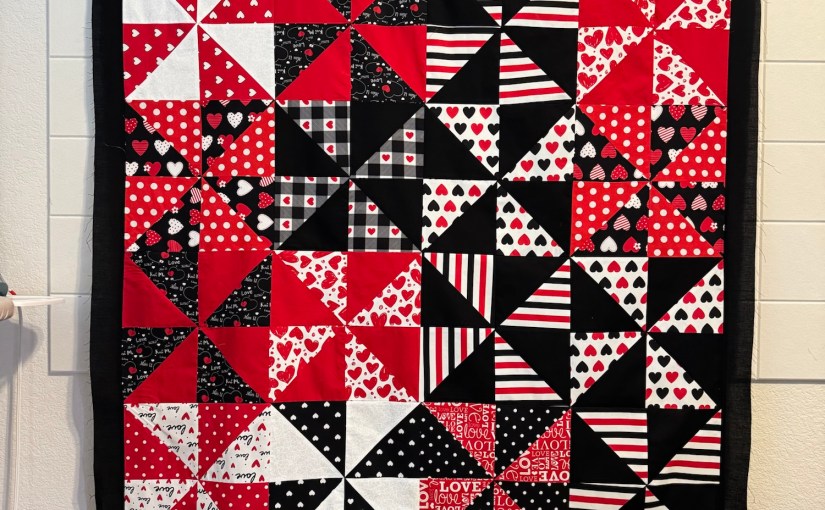
Quilting started as a hobby. It has since evolved into emotional regulation… and an entirely unhinged fabric acquisition strategy.

When my brain feels loud and life feels like it’s happening all at once, quilting is the one thing that reliably quiets everything down. Measuring, cutting, piecing, pressing—my thoughts don’t stand a chance against a quarter-inch seam allowance.

Quilting demands just enough focus to keep me out of my own head.

You can’t spiral while trying to line up points. You can’t overthink when the fabric is actively trying to slide away from you. Quilting insists on presence, whether you’re ready for it or not.

And it’s physical in the best way.

The weight of folded fabric. The snick of the rotary cutter. The iron hissing like it’s judging you. The steady hum of the machine. It’s impossible to doom-scroll while quilting—which is unfortunate for my phone, but excellent for my nervous system.

Quilting is different than other crafts.

This isn’t instant gratification. Quilts take time. Weeks. Months. Sometimes years. Quilting teaches patience through mild frustration and repeated seam ripping. It also teaches acceptance—because at some point you decide that seam is close enough and move on with your life.

Other crafts chase perfection. Quilting gently whispers, “No one will see that once it’s quilted.”

And then there’s the fabric.

I do not have a fabric stash. I have a fabric collection. A carefully curated, emotionally significant archive of potential futures. Each piece has a purpose. Not a plan—a purpose. There is a difference.

Fabric hoarding is not about excess. It’s about preparedness.

What if I need it for this quilt? What if I never find it again? What if I don’t use it for five years but then suddenly it’s PERFECT? These are valid concerns and I will not be taking questions at this time.

Quilting humbles you regularly.

You sew something wrong. You seam rip it. You sew it wrong again. You question all your life choices. Then somehow, miraculously, it comes together. Quilting is basically resilience training with cotton.

But here’s the thing—it works.

Some days I quilt for joy.

Some days I quilt because my emotions are doing parkour.

Some days I quilt because keeping a pile of fabric organized feels easier than organizing my thoughts.

Quilting doesn’t fix everything.

But it gives my hands something steady to do while my brain sorts itself out. It reminds me that progress can be slow and still be progress. That messy pieces can become something beautiful. That it’s okay to pause, adjust, and keep going.

I didn’t mean to sew my way to sanity.

But here I am—surrounded by fabric, half-finished quilts, and the quiet comfort of knowing that if nothing else makes sense today, I can always line up another seam.

And honestly?

That—and maybe just one more yard of fabric—is enough.

Blessings y’all – Amy

Today Is Mom’s Birthday

Today is my grandma’s birthday. We called her Mom.

My mother was 17 when she had me and we lived with my grandparents in my early years. I grew up hearing her be called Mom and it stuck. Somehow, that name fit her perfectly.

Birthdays after someone is gone are strange things. They don’t announce themselves loudly, but they sit with you all day. They show up in quiet moments—when you’re folding laundry, when you smell something familiar, when your hands are busy and your mind wanders back to her without asking permission.

Some of my deepest comforts came from Mom. Sewing, for one. My love of sewing—of fabric, and texture, and making something useful and beautiful with my hands—came straight from her. When I sew now, it feels like a conversation that never really ended. Every stitch carries a little bit of her patience, her practicality, her quiet creativity. It still feels like being close to her, even all these years later.

Then there’s the food. I miss her slumghetti—that wonderfully imperfect, comforting dish that somehow tasted like home no matter how simple it was. No one else makes it quite the same, and maybe that’s the point. It wasn’t just about the meal; it was about the care behind it, the way she made it for me as many times as I asked as an act of love.

Some of the moments I miss most are the smallest ones. When I was little and didn’t want to nap, she’d let me hold her ring finger while she told me to “rest my eyes.” I can still feel it—how safe that felt, how the world quieted down just enough. That tiny gesture held so much comfort. It was her way of saying, I’m here. You’re okay.

Mom had that rare gift of making you feel steady just by being present. Not the dramatic kind of safe—the quiet kind. The kind where the edges of the world soften. Where you don’t have to explain yourself. Where being loved is as natural as breathing.

I think about the lessons she taught without ever formally teaching them. How love looks like showing up. How strength can be gentle. How kindness doesn’t have to be loud to be powerful. How family is built on consistency, not perfection.

There are days I wish I could tell her who I’ve become since she left. About the life I’m building. About the ways her influence still shows up—in my hands, in my kitchen, in the way I care for the people I love. I think she’d smile at that.

Sometimes I catch myself doing something and think, That’s Mom. A habit. A phrase. A moment of patience I didn’t know I had. And when that happens, the ache softens, because it reminds me she’s still here—stitched into who I am.

Today, on her birthday, I miss her deeply. I miss her hands, her food, her quiet reassurances. But I’m also grateful. Grateful for a love so strong that it still shows up in the smallest moments of my life.

Happy Birthday, Mom.

I still hold your hand—just in different ways now.

Blessings Y’all – Amy

The Valentine’s Day Conundrum

Valentine’s Day is one of those holidays that manages to be wildly polarizing. Some people circle it on the calendar with hearts and anticipation, while others would happily fast-forward from February 13th straight to the 15th without so much as a glance at a pink card aisle (used to be me!). Few days stir up as many opinions, eye rolls, expectations, and emotions—all wrapped in red cellophane.

For the people who hate Valentine’s Day, the reasons are usually layered. It can feel commercialized, performative, or painfully loud about something that feels tender and private. It can highlight loneliness, loss, or relationships that didn’t turn out the way they were supposed to. It can remind you of love that you had – and lost. Sometimes it just feels exhausting to be told—by ads, social media, and store displays—what love should look like and how it should be celebrated.

And then there are the people who love it. Not because of the chocolate or the flowers (though those don’t hurt), but because it’s an excuse to pause. To be intentional. To say “I choose you” out loud in a world that moves too fast. For them, Valentine’s Day isn’t pressure—it’s permission. It’s the day you can shout to the rooftops how loved and seen they make you feel.

The truth is, both sides make sense.

Love is complicated. It’s joyful and messy, exhilarating and fragile. Some of us have loved deeply and lost. Some of us waited a long time to find the kind of love that feels safe. Some of us are still learning how to let ourselves be loved at all. Of course a holiday built entirely around love is going to hit differently depending on where you stand.

But here’s where the conundrum softens.

Valentine’s Day doesn’t actually belong to restaurants, greeting card companies, or curated Instagram posts. At its core, it belongs to love itself—the real, lived-in kind. The love that shows up on ordinary Tuesdays. The love that knows your quirks and stays anyway. The love that holds your hand through grief, growth, and grocery store errands. The love that brings you home yet another plant when you didn’t need one just because it makes you smile.

Being in love—real love—isn’t about grand gestures once a year. It’s about choosing each other in small, steady ways. It’s about laughter in the kitchen, quiet understanding, and feeling seen without needing to explain yourself. It’s about sitting in the bed watching TV because the chairs in the living room hurt your back. When you’re in that kind of love, Valentine’s Day becomes less of a performance and more of a gentle nod. A reminder.

And maybe that’s the shift worth making.

Instead of asking whether Valentine’s Day is worth celebrating, maybe the better question is whether love is worth acknowledging. Whether we can let the day be soft instead of loud. Honest instead of perfect. Whether we can hold space for both the joy of being in love and the ache of having loved before.

You don’t have to love Valentine’s Day to be in love. And you don’t have to hate it to take it lightly. But if you are in love—deeply, imperfectly, beautifully—there’s something quietly lovely about a day that says, “This matters.”

Not because a calendar told us so.

But because love always has.

Blessings Y’all – Amy

Plants, Anxiety, & Me

Anxiety has a way of making a home feel louder than it actually is.

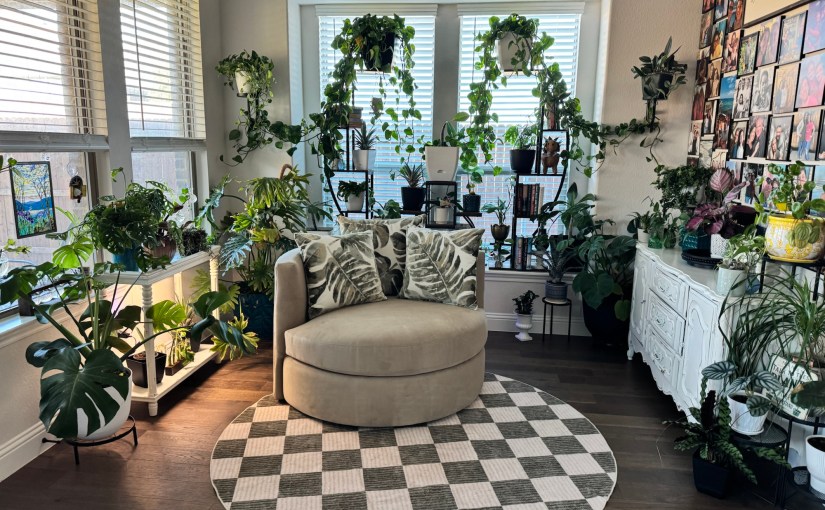
Thoughts race. The air feels heavy. Everything feels slightly unfinished. Somewhere along the way, I realized that filling my home with plants didn’t just change how it looked—it changed how it felt.

Plants slow things down.

When anxiety pulls my mind into the future—into the what-ifs and worst-case scenarios—plants quietly anchor me in the present. They don’t rush. They don’t demand answers. They exist, steadily and without apology, and somehow that’s calming.

Caring for plants gives my anxious brain something to hold onto.

Watering, checking leaves, rotating pots toward the light—it’s repetitive and predictable in the best way. When my thoughts feel chaotic, plants offer structure without pressure. They don’t need me to have it all together. They just need me to show up.

Depression shows up differently.

Some days it looks like low energy. Other days it looks like indifference. On those days, plants become a gentle nudge instead of a demand. Opening the blinds. Pouring water. Noticing a new leaf. Small actions, but meaningful ones. Proof that I can still care for something—even when caring for myself feels harder.

Plants keep me grounded in now.

Anxiety lives in the future. Depression lingers in the past. Plants live firmly in the present moment. You notice what’s happening today: a drooping leaf, fresh growth, soil that needs water. They pull you out of your head and into your hands without asking you to try.

They also teach patience—and humility.

Some plants thrive effortlessly. Others struggle no matter how much love you give them. (I’m looking at you, fiddle leaf fig.) They remind me that growth isn’t linear and that setbacks aren’t personal failures. Sometimes things just need time, light, and fewer expectations.

There’s comfort in having something alive in your space.

Green softens a room. Sunlight through leaves feels hopeful. Even on hard days, plants are quiet proof that life continues at its own pace.

Plants don’t fix anxiety or depression.

But they help.

They create calm. They offer routine. They remind me to breathe, to slow down, to notice. And sometimes, when my brain feels loud and heavy, keeping a plant alive feels like a small but meaningful victory.

Plants, anxiety, and me—learning how to grow together, one day at a time.

Blessings y’all – Amy

PawPaw’s Birthday

Today is my Pawpaw’s birthday.

Almost twelve years have passed since we lost him, and that number still surprises me. You’d think time would sand the edges down more than it has. It does soften some things—the sharpest ache, the shock of realizing he’s gone—but it never erases him. Not really. Not the way someone like Pawpaw could ever disappear.

There are days when I don’t think about him much at all, and then there are days like today when he feels right there. In the pauses. In the memories that show up uninvited. In the garden when the sun warms my face and it feels like one of his hugs. In the way I still catch myself wishing I could tell him something small and ordinary, just to hear what he’d say.

What I miss most isn’t one single moment or story. It’s the steadiness of him. The feeling that no matter what was going on in the world, Pawpaw was solid and safe and exactly who he’d always been. He didn’t need to be loud to be influential. He didn’t need to say much to say enough. Just being Pawpaw was more than sufficient.

Grief this far out looks different than it used to. It’s quieter. It doesn’t knock the wind out of me the way it once did. But it’s persistent in a gentle way, like a low hum that never fully goes silent. I miss him when something good happens. I miss him when life feels heavy. I miss him when my roses bloom and remind me of him. I miss him when I laugh at something and think, he would’ve loved that.

Birthdays have a way of doing that—of reopening doors you didn’t realize were still unlocked. Today isn’t sad exactly, but it’s tender. It’s a reminder that love doesn’t expire just because someone does. Almost twelve years later, Pawpaw is still part of who I am, still woven into my life in ways time can’t undo.

Happy birthday, Pawpaw. You are still missed. Still loved. Always remembered.

Blessings y’all – Amy

What’s Changed in 19 Years…

Today would have been my 19th wedding anniversary with Fred.

That sentence still lands with weight.

Not because I am stuck there. Not because I want to go back. But because love leaves fingerprints on time, and some dates never become neutral again.

Nineteen years ago, I married a man who shaped me. We built a life in the way couples do—messy, hopeful, unfinished. We grew up together. We learned who we were by learning how to be married. And when he died, that chapter didn’t close neatly. It ended mid-sentence.

Grief doesn’t respect calendars, but anniversaries have a way of knocking anyway.

What anchors me on days like today is gratitude.

Because the love we shared didn’t disappear with him. It lives on in the children he shared with me, in the family we built together, in the relationships and roots that still surround my life. I am profoundly grateful for that legacy. For the laughter that still sounds like him. For the people who carry pieces of him forward without even realizing it. For the fact I can still see his smile in our children’s. He didn’t just leave me memories—he left me a family.

And here’s the part that still feels strange to say out loud: I am deeply, fully, undeniably in love with Tim.

Not instead of loving my Fred.

Not in competition with that love.

Just… also.

For a long time, I thought love worked like a single chair—you vacate it, or you sit in it. One at a time. I didn’t understand that love is more like a house. Rooms get added. Some doors stay closed most days, but they’re still there.

Today is one of those days when an old door creaks open.

I can miss the man I lost and still laugh with the man I married.

I can honor a marriage that ended in death and still be fiercely committed to the one I’m in now.

I can feel the ache of “what would have been” without wishing away what is.

Loving my Tim does not erase my past. And remembering my Fred does not diminish my present.

That’s the juxtaposition people don’t talk about enough—the quiet coexistence.

Tim didn’t replace Fred. He met me after loss reshaped me. He loves a woman who knows how fragile life is, how precious ordinary days are, how deeply commitment can root itself in the bones. He loves me with patience on days like today, when the calendar carries more emotional weight than usual. And that love is not smaller because it came later. If anything, it is more intentional.

Grief taught me that love is not scarce. It expands. It stretches. It surprises you.

So today, I hold both truths.

I remember the man I married nineteen years ago, with gratitude—for our life, for our children, for the family he left behind that still carries me forward.

And I choose the man I wake up next to now, with joy, loyalty, and a full heart.

Both can be true.

Both are true.

And that doesn’t make love complicated.

It makes it real.

Blessings y’all – Amy

Loving Senior Dogs

Nobody tells you how quietly it happens.

One day your dog is bounding through the house, nails clicking, tail wagging so hard it knocks into furniture. And then one day you notice they hesitate before jumping on the couch. They sleep a little deeper. Their face starts to gray in places you swear were brown yesterday.

Having senior dogs is a lesson in noticing.

You notice the way walks get shorter but more intentional. The way they follow you less and watch you more. The way their eyes still light up for food, sunshine, and your voice—even when their bodies don’t cooperate the way they used to.

Senior dogs change the rhythm of your life.

Schedules revolve around medications, vet visits, special diets, and accommodations you never thought about before. Ramps replace stairs. Rugs appear where floors used to be bare. You learn where the nearest emergency vet is without thinking. You start measuring time differently—not in years, but in good days.

And yet… there is something deeply sacred about this stage.

They no longer care about impressing anyone. They aren’t interested in chaos or novelty. What they want is simple: comfort, consistency, and you. They choose their spots carefully. They soak up warmth like it’s their job. They love slower mornings and familiar routines.

Their love becomes quieter, but no less fierce.

There’s a weight to loving a senior dog because you’re always holding two truths at once. You’re grateful they’re still here, and you’re painfully aware that time is not infinite. Every limp, every off day, every vet appointment carries a question you don’t want to ask yet.

But loving them anyway—fully, intentionally—is the whole point.

Senior dogs teach you how to be present.

They teach patience when plans change. Compassion when bodies fail. Acceptance when things are out of your control. They don’t need grand gestures. They need you to show up, again and again, in the small ways: refilling the water bowl, adjusting the blanket, sitting on the floor because they can’t climb onto the couch anymore.

They give you everything they have left.

And if you’re lucky, you get to give it back to them in the form of dignity, comfort, and love at the end of their story.

Loving a senior dog is not for the faint of heart. It’s emotional. It’s expensive. It’s exhausting. And it’s absolutely worth it.

Because when they look at you—old, tired, still trusting—you realize something important:

They were never just a phase of your life.

You were their whole life.

Joy, Reba, Lilah – that is a responsibility, and an honor, I will never take lightly.

Blessings y’all – Amy